
Non-Catalytic Wood Stoves
(1 products)Non-catalytic wood stoves achieve EPA 2020 certified clean combustion through preheated secondary air injected via stainless steel tubes above the firebox. No catalyst to inspect, monitor, or replace. Compare with catalytic in the Enerzone comparison guide.
- Featured
- Most relevant
- Best selling
- Alphabetically, A-Z
- Alphabetically, Z-A
- Price, low to high
- Price, high to low
- Date, old to new
- Date, new to old
FiltersFilter & Sort
Buck Stove Model 21 Non-Catalytic Wood Stove
Regular priceFrom $2,410.00Unit priceIn stock (13 units)-
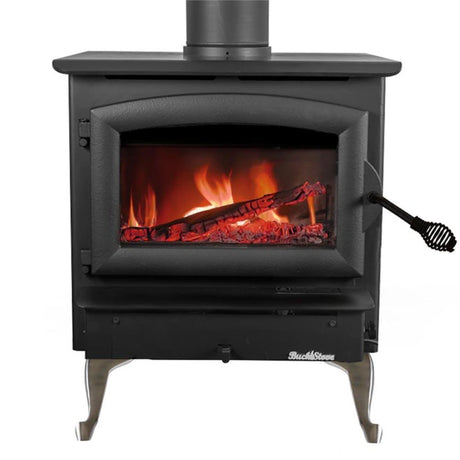
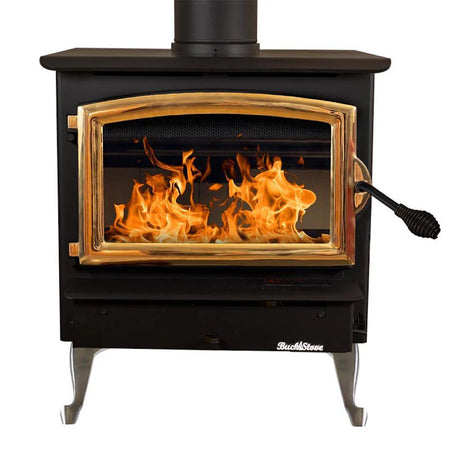
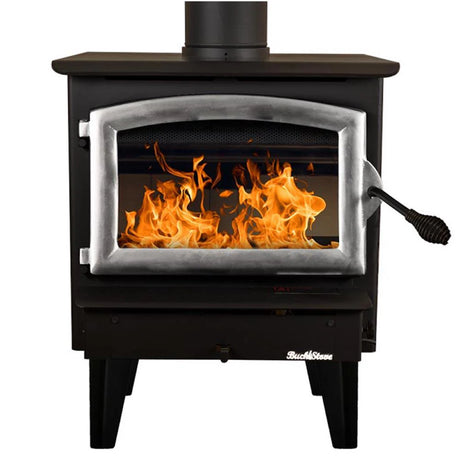
How non-catalytic secondary combustion works
Non-catalytic wood stoves use three stainless steel secondary air tubes installed above the firebox. Preheated air is drawn from outside the firebox, heated by the firebox walls, and injected through holes in the tubes into the upper firebox where it mixes with rising combustion gases at high temperature. The mix ignites and burns the remaining particulates and gases, achieving EPA-certified clean combustion without a catalyst.
Why pick non-catalytic
Three advantages. First, no catalyst to maintain: no inspection schedule, no replacement cost every 10,000-12,000 hours. Second, faster light-off from cold start: secondary combustion begins firing as soon as the firebox is hot, no separate catalyst light-off threshold. Third, simpler operation: the air control directly adjusts combustion air with no bypass damper sequence to learn.
EPA 2020 compliance
All our non-catalytic wood stoves meet the U.S. EPA 2020 emission standard for wood heaters (CFR 40 part 60, subpart AAA). Emission rates run from 1.6 g/hr (Empire Gateway 3500, the cleanest in our lineup) to 4.4 g/hr (Buck Stove Model 21, still EPA 2020 compliant). Higher average efficiency LHV ratings range from 73 to 77 percent across our non-catalytic lineup.
Models in this collection
The non-catalytic lineup covers the full size range. The Enerzone Solution Series (1.4, 1.7, 2.3) and Empire Gateway Series (1700, 2300, 3500) span 250 to 2,700 square feet of heating capacity. The Buck Stove Model 21 is the compact non-catalytic with factory blower included and mobile home approval. The Breckwell SW500 is a small-format non-catalytic option.
FAQ
What is a non-catalytic wood stove? A wood stove that achieves EPA-certified clean combustion through preheated secondary air injected above the firebox, rather than through a ceramic catalyst combustor.
Is non-catalytic better than catalytic? Simpler operation, lower long-term maintenance, faster cold-start light-off. Catalytic stoves offer lower emissions and longer sustained burns at low burn rates. The choice depends on use pattern.
Do non-catalytic wood stoves need maintenance? Standard wood stove maintenance: chimney cleaning, gasket inspection, glass cleaning, and ash removal. No catalyst to replace and no monitor probe to check.
Are non-catalytic stoves EPA certified? Yes. Every non-catalytic wood stove in this collection meets the EPA 2020 emission standard for wood heaters.
Browse related collections: All Stoves · Wood Stove Inserts · Small Wood Stoves · Large Wood Stoves · Catalytic Wood Stoves · Non-Catalytic Wood Stoves · Mobile Home Approved.